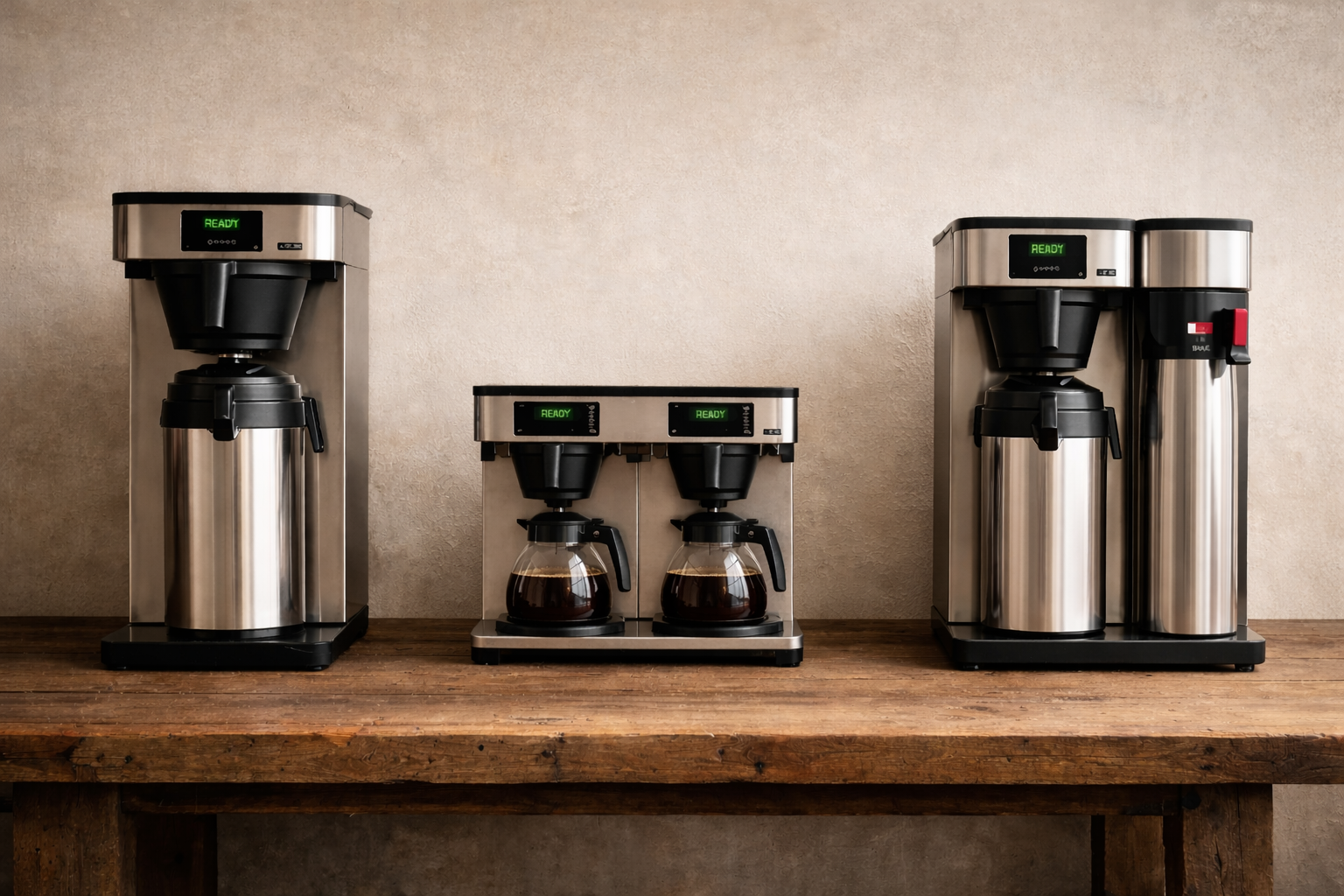
The Batch Brewer:
A Guide to Consistency
Craft. Connection. Simplicity.
In the rhythm of a busy day, the batch brewer is not a shortcut; it is a steady anchor. It allows us to serve exceptional coffee to many, without sacrificing the intention behind a single cup.
We believe that true quality is not about diving into complicated topics; it is about doing simple things with great care. Whether you are serving a crowded room or a quiet few, this guide ensures that every liter reflects the quality of great coffee that your guests deserve.
1. The Foundations: The Ratio
Consistency begins with mathematics, but it ends with taste.
In manual brewing, such as a pour-over, we often start with a ratio of 1:15, calibrating later to 1:16 or 1:17 depending on the nuance of the roast.
However, the batch brewer is a tool of rhythm. Here, we prioritize practicality and consistency. We propose a standard measure of 60 grams of coffee for every 1 Liter of water (a ratio of 1:16.6).
Why this specific number? Because it simplifies the workflow without sacrificing quality. It removes the friction of awkward decimals—like weighing 62.5g for a 1:16 ratio or 58.8g for a 1:17. Instead, we use a clean, precise standard that allows you to move with confidence .
The Standard: 60 grams of coffee for every 1 Liter of water.
Quick Reference:
- 1 Liter: 60g Coffee
- 1.5 Liters: 90g Coffee
- 2 Liters: 120g Coffee
- 3 Liters: 180g Coffee
- 4 Liters: 240g Coffee
- 5 Liters: 300g Coffee
2. The Variables
Before the water touches the coffee, three elements must be aligned. By stabilizing these variables, we strip away the unnecessary and focus only on the essential.
- The Water: It is the canvas of your coffee. Use filtered, soft water. If the water is not pure, the coffee cannot shine.
- The Temperature: Set your machine between 93°C and 96°C. This specific window extracts the natural sweetness and character of the bean without burning its delicate notes.
- The Grind: Texture matters. We seek a medium-coarse grind—finer than a French Press, but coarser than a hand-pour.
- The Feel: It should resemble coarse sea salt. It should feel gritty and loose between your fingers, never powdery or sandy.
- The Feel: It should resemble coarse sea salt. It should feel gritty and loose between your fingers, never powdery or sandy.
3. The Process: Step by Step
I. The Rinse
Place your paper filter into the basket and rinse it thoroughly with hot water. This simple act washes away paper dust and warms the metal, ensuring the brewing temperature remains stable from the very first drop. Discard the rinse water before proceeding.
II. The Dose
Weigh your beans with precision. Do not rely on scoops or guesses. We honor the farmer’s work and your guests by being exact with our measurements. Grind fresh, right before you brew.
III. The Bed
Pour the ground coffee into the filter. Gently shake the basket to level the grounds. A flat, even bed ensures the water flows through the coffee uniformly, extracting flavor from every particle equally.
III. The Brew
Slide the basket into place. Select your volume. Begin the cycle.
- Note: If your machine offers a “bloom” phase, engage it. This brief pause allows the coffee to release gas and accept the water more willingly.
IV. The Homogenization
This is the step often forgotten, yet it is vital. As coffee brews, it layers itself—heavy and strong at the bottom, light and weak at the top. To serve a balanced cup, you must marry these layers.
- For Airpots: Close the lid and gently tilt the vessel upside down, then upright.
- For Carafes: Swirl the vessel gently, or use a spoon to fold the liquid together.
4. Troubleshooting: Aligning the Taste
Even with the best intentions, results can vary. To fix the coffee, you must first understand what your palate is telling you.
The Sensory Key: Diagnosis Before Action
Use this simple guide to distinguish between sensations that are often confused.
- Bitterness (The Taste): A harsh, penetrating flavor. It tastes like aspirin, tonic water, or burnt toast. It lingers on the back of the tongue.
- Overwhelming Intensity (The Weight): This refers to the perception of “body”. A sensation of heavy saturation. Coffee feels thick and syrupy, like drinking fruit syrup without water. The flavor may be good, but it is too overwhelming.
- Astringency (The Texture): A tactile sensation that gives the impression of physical friction or dryness. It feels like sandpaper on your tongue or the pucker of an unripe banana. It sucks the moisture from your mouth.
Depending on your diagnosis, locate your specific sensation below to find the unequivocal path to a better cup. Trust your palate. If the coffee does not taste right, listen to what it is telling you and adjust one variable at a time.
The Solution Chart
| The Sensation | The Diagnosis (The Problem) | The Action (The Fix) |
| Dryness, Sandpaper, Pucker | Astringency. This is not a taste; it is a physical reaction. The coffee was severely over-extracted or “channeled.” The water found a weak spot and drilled through, pulling out harsh tannins. | Coarsen the grind. If the bed is flat, your grind is simply too fine. Make the grind much coarser to stop the water from dragging out dry tannins. |
| Bitter, Harsh, Medicine-like | Over-Extraction. The grind was too fine (like sand). The water, trapped by the density, lingered too long. It dissolved beyond the sweet spot, pulling out the bitterness of the plant fibers. | Coarsen the grind. Adjust to a texture like rough sea salt. This eases the flow and shortens the contact time, ensuring the water captures only the sweetness before passing through. |
| Sour, Salty, Watery | Under-Extraction. The grind was too coarse (like rocks). The water flowed through too easily without grabbing enough sugar or flavor. | Fine the grind. Adjust to a slightly smaller particle size. This slows the flow and extends the contact time, giving the water the opportunity to capture the desirable flavors it missed. |
| Heavy, Syrupy, Overwhelming | High Intensity. The extraction is likely correct (no bitterness), but the concentration is too high. The coffee is too strong to drink comfortably. | Reduce the Dose. Use slightly less coffee (e.g., 58g per Liter). This lightens the weight while keeping the flavor profile intact. |
| Weak, Thin, Empty | Low Intensity. The flavor is pleasant (not sour), but the body is lacking. It feels like tea or flavored water. | Increase the Dose. Use slightly more coffee (e.g., 62g per Liter). This adds body, texture, and presence to the cup. |
Pro Tip: The Water Test
Unsure if your coffee is Bitter or just Intense? Add a splash of hot water to your cup.
- If it becomes sweet and delicious, it was just Intense (Fix: Reduce Dose).
- If it stays harsh and dry, it is Bitter (Fix: Coarsen Grind).
A Final Note
Great coffee does not need to be complicated.
It simply requires respect for the process and the tools.
Keep your equipment clean, your water fresh, and your mind clear.